|
Research Article
Adverse effects of tuberculosis on voice in Bangladesh
1 Speech and Language Therapist, Centre for the Rehabilitation of the Paralysed (CRP), Savar, Dhaka 1343, Bangladesh
2 Assistant Professor, Speech and Language Therapy Department, Bangladesh Health Professions Institute (BHPI), the Academic Institute of Centre for the Rehabilitation of the Paralysed (CRP), Savar, Dhaka 1343, Bangladesh
3 Senior Medical Officer, Infectious Disease Division (ACTB Project), icddr,b, Dhaka, Bangladesh
Address correspondence to:
Rabeya Israt Oeshy
CRP, Chapain, Savar, Dhaka 1343,
Bangladesh
Message to Corresponding Author
Article ID: 100060D05RO2026
Access full text article on other devices

Access PDF of article on other devices

How to cite this article
Oeshy RI, Parvez N, Islam MS. Adverse effects of tuberculosis on voice in Bangladesh. Edorium J Disabil Rehabil 2026;11(2):1–7.ABSTRACT
Aims: This study aimed to assess severity of voice disorders among tuberculosis (TB) patients and to explore pulmonologists’ perceptions regarding the role of speech and language therapy in TB-related voice disorders.
Methods: A mixed-methods embedded design was employed. A total of 186 TB patients were selected using random sampling, and 5 pulmonologists were recruited purposively. Voice Handicap Index-30 (VHI-30) and a demographic questionnaire were used for quantitative data collection, while a self-structured open-ended questionnaire was used for qualitative data from pulmonologists. Quantitative data were analyzed using descriptive statistics, and qualitative data were examined through content analysis.
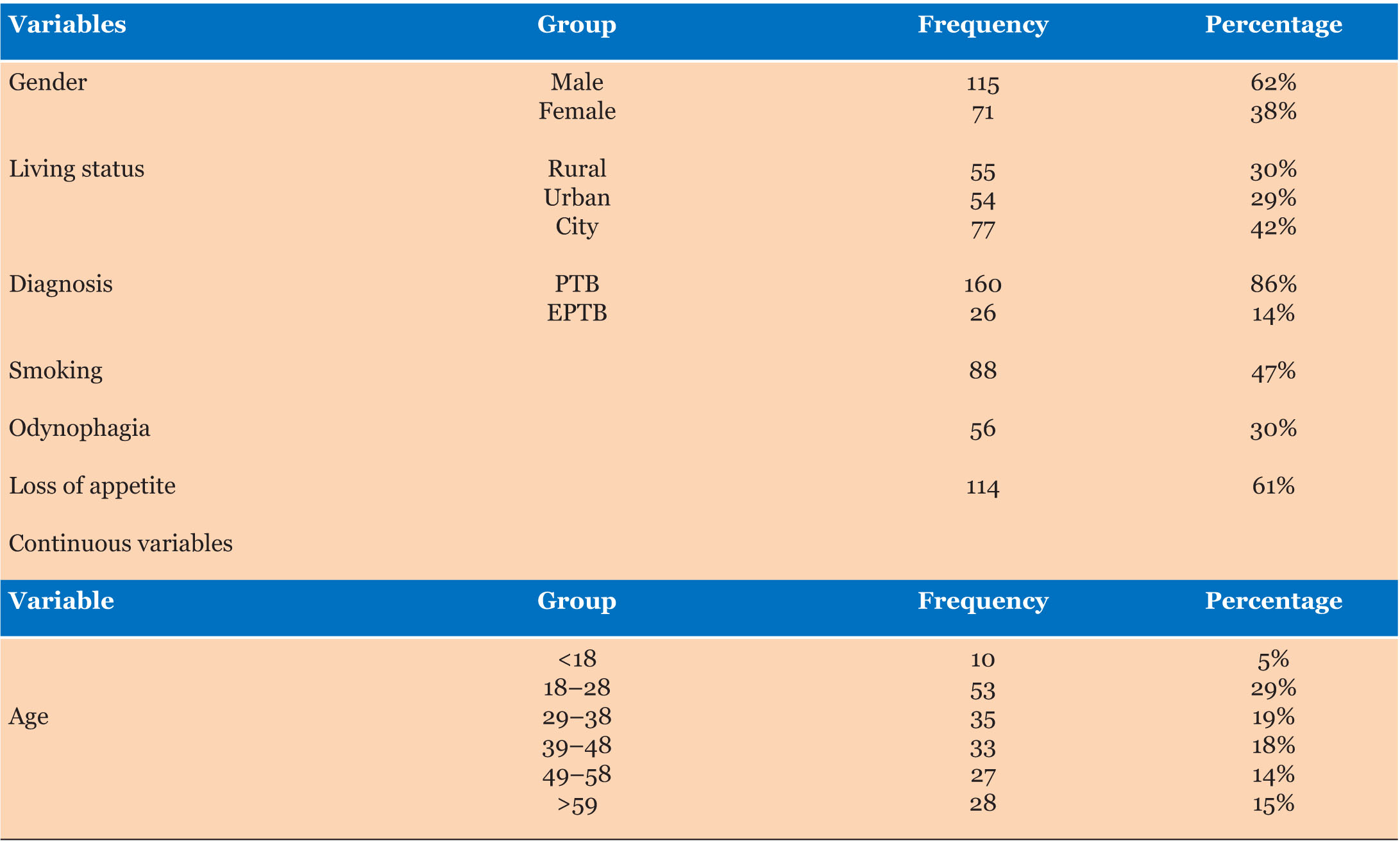
Results: The study population comprised 61.8% males and 38.2% females, with the largest age group being 18–28 years (29%). Pulmonary TB was present in 86% of participants. Based on VHI-30 scores, 75.8% had mild, 21% moderate, and 3.2% severe voice handicap. The mean VHI-30 score was 18.42 ± 17.14. Smoking history, odynophagia, and prior voice problems showed associations with increased voice impairment. Loss of appetite was reported by 61% of the participants. Anti-tubercular therapy was associated with improvement in voice-related outcomes. Qualitative findings indicated variability in pulmonologists’ awareness and understanding of the role of speech and language therapists in the management of tuberculosis-related voice disorders.
Conclusion: Tuberculosis has a measurable impact on vocal function, with most patients demonstrating mild to moderate voice impairment. Lifestyle and clinical factors such as smoking and odynophagia contribute to severity. However, the findings underscore the importance of enhancing knowledge of speech and language therapy among pulmonologists to facilitate interdisciplinary cooperation and optimize patient outcomes.
Keywords: Odynophagia, Pulmonologists, Speech and language therapy, Tuberculosis, Voice disorder
SUPPORTING INFORMATION
Acknowledgments
We are very thankful to all the participants for their voluntary participation.
Author ContributionsRabeya Israt Oeshy - Substantial contributions to conception and design, Acquisition of data, Analysis of data, Interpretation of data, Drafting the article, Revising it critically for important intellectual content, Final approval of the version to be published
Nahid Parvez - Substantial contributions to conception and design, Acquisition of data, Analysis of data, Interpretation of data, Drafting the article, Revising it critically for important intellectual content, Final approval of the version to be published
Mohammad Shirajul Islam - Substantial contributions to conception and design, Acquisition of data, Analysis of data, Interpretation of data, Drafting the article, Revising it critically for important intellectual content, Final approval of the version to be published
Guaranter of SubmissionThe corresponding author is the guarantor of submission.
Source of SupportNone
Consent StatementWritten informed consent was obtained from the patient for publication of this article.
Data AvailabilityAll relevant data are within the paper and its Supporting Information files.
Conflict of InterestAuthors declare no conflict of interest.
Copyright© 2026 Rabeya Israt Oeshy et al. This article is distributed under the terms of Creative Commons Attribution License which permits unrestricted use, distribution and reproduction in any medium provided the original author(s) and original publisher are properly credited. Please see the copyright policy on the journal website for more information.